Category: Uncategorized

  • Networking Done Right: Building Real Relationships That Open Real Doors

    The Uncomfortable Truth About Your Career

    Let me be direct: your resume doesn’t matter. Your skills don’t matter. Your portfolio, your certifications, your years of experience – they might not matter either. Here’s what does: who you know, and whether they think of you when an opportunity shows up.

    The data backs this up. 85% of jobs are filled through networking. Not job boards. Not LinkedIn job postings. Networking. Real, actual human connections. Yet despite knowing this, most people treat networking like homework – something to do when they feel obligated, something that makes them uncomfortable.

    Even worse? 79% of professionals agree that networking is essential for career growth. But only 48% actually maintain their networks regularly. And 38% say it’s just too hard – too time-consuming, too awkward, too much. What they’re really saying is: “I’m not prioritizing the one thing that matters most for my career.”

    “Business executives would lose 28% of their business if they stopped networking.” – LinkedIn Career Study

    Think about that. A quarter of your potential opportunities disappear the moment you stop showing up for people. That’s not motivation – that’s just math.

    Authentic Networking Is The Opposite Of Contact Collecting

    Here’s the mindset shift you need: networking isn’t about collecting business cards or LinkedIn connections. That’s surface-level and it doesn’t work. Real networking is about building actual relationships based on genuine interest – not what someone can do for you, but who they are as a person.

    There’s a fundamental difference between transactional networking (hey, I need something from you) and trust-based relationships (I actually care about your success). And here’s the thing – people can feel the difference immediately.

    So what does this look like in practice? Three concrete strategies:

    1. Ask Questions. Shut Up. Actually Listen.

    Instead of launching into your entire bio, ask open-ended questions. “What project are you excited about right now?” beats “What do you do?” by a mile. Then listen – actually listen – without planning what you’ll say next. People feel heard when you’re genuinely interested. It’s rarer than you think.

    2. Follow-Up Isn’t Transactional – It’s Structural

    This is where most people fail. 49% of professionals cite time as the reason they lose touch with their network. But here’s what separates top performers: they have a system. A 2024 study found that companies with structured networking approaches achieved 38% better results than those using ad-hoc methods. That’s not talent – that’s strategy.

    What does this mean? Write things down. Note that Sarah got promoted. Mark that Thomas is launching his startup. Then schedule follow-ups. Not “I’ll reach out sometime,” but “I’m messaging Sarah on the 15th of every month.” That’s professional maturity.

    3. Use Tools Because Your Brain Isn’t Made for This

    Here’s something most people don’t realize: businesses have been using CRM (Customer Relationship Management) systems for decades because they know the human brain can’t track hundreds of relationships without help. Salesforce is a multi-billion-dollar industry because companies understand this fundamental truth: relationships without structure collapse.

    Yet most people try to keep their entire network in their head. And it shows. In 2024, 44% of business owners use CRM systems to manage contacts. Only 31% rely on email or their phone. The difference? Top performers never miss a birthday, never forget a job change, never miss a moment to show up for someone.

    That’s where tools like HighFive come in. It’s not about being robotic – it’s about being intentional. When you track important milestones and get reminders, you can actually show up for people consistently. You’re not fighting your memory. You’re augmenting it.

    The Science Of Follow-Up: How Often Is Too Often?

    There’s a sweet spot. Too frequent feels pushy. Too infrequent feels like neglect. Most people land somewhere in the middle, acting randomly instead of strategically.

    Habit formation research shows that consistent behavior becomes automatic after about 66 days. Translation: if you reach out to someone every two weeks, after 4-5 months it stops feeling like work. It becomes routine. But you have to actually do it for 4-5 months first.

    That’s why structure matters. Structure is what gets you through those first months until it becomes automatic.

    Sources:

    • LinkedIn – Networking Statistics 2024-2025
    • The Impact of Networking on Career Growth, Harvard Economics
    • Networking Statistics 2025 – Global Study Data
    • Strategic Networking Performance Study, 2024
    • HighFive – Smart Reminders for Important Milestones

  • Personal CRM: Your Secret Weapon for Meaningful Relationships

    Why Companies Use CRM And You Should Too

    Your company spends hundreds of thousands of dollars on CRM software. Salesforce. HubSpot. Pipedrive. And you know what these systems do? They remember everything. Every interaction. Every preference. Every important date. The software basically says: “I’m not letting you forget about anyone who matters to your business.”

    Then you go home and you can’t even remember that your best friend got promoted two months ago.

    That’s not laziness. That’s a system failure. And honestly, if that bothers you – if you feel guilty about forgetting important stuff about people you care about – then you understand exactly why a personal CRM actually makes sense.

    A personal CRM isn’t cold or transactional. It’s the opposite. It’s a system that frees you to be more present, more thoughtful, and more genuinely connected. It takes the burden of remembering off your shoulders so your brain can focus on what actually matters: real human connection.

    “With the right system, you show people you actually care – and stay authentically connected.”

    What Personal CRM Actually Does (And Why Businesses Have Known This For Decades)

    Let’s talk facts: 72% of companies use CRM systems to track interactions and customer history. It’s not niche. It’s standard. And it works. Companies with CRM have better retention, stronger relationships, and aren’t scrambling when clients reach out.

    So what’s it actually doing? Three things:

    1. It Frees Up Your Brain’s Bandwidth

    Your brain isn’t designed to store 200 contacts’ names, hobbies, birthdays, job changes, and conversation histories. You’re meant to think, create, and feel – not be a biological hard drive. A personal CRM is basically outsourcing the grunt work to technology so your brain can focus on what matters: being present in actual conversation.

    2. It Makes Genuine Presence Possible

    If you don’t remember that Alex just started her own company, you can’t genuinely support her. If you don’t know that Marcus was going through a tough time, you can’t show real care. A CRM is the infrastructure for empathy. It gives you the information you need to actually show up for people.

    Research shows something powerful: remembering personal details and referencing them later is one of the strongest ways to show respect. It says, “I listened. You matter. I remember you.”

    3. It Creates Consistency Without Burnout

    Here’s the paradox: the people who try to manage everything in their head are the most stressed. The ones with a system are calm. Why? Because they’re not constantly anxious about “Oh God, I should have called Michael three weeks ago.” The system handles it. Your mind is free.

    Practical: What To Track In Your Personal CRM

    You don’t need to be Fortune 500 about this. You don’t need 47 fields per person. But these essentials matter:

    • Basics: Name, how you met, their job, their interests
    • Milestones: Birthday, anniversary, new job, moved cities, wedding, kids, big life events
    • Last Conversation: When you last talked and what about
    • Next Step: When do you want to reconnect? With whom?
    • Notes: “Loves coffee,” “Just started at Company X,” “Got a dog,” personal details that matter

    This isn’t creepy. It’s respectful. Tools like HighFive make this seamless – they track these details and send you intelligent reminders so you never miss a moment to show up for someone.

    The Psychology Behind Relationship Management: Your Brain Has Limits

    Dunbar’s Number is the idea that humans can comfortably maintain about 150 stable relationships. But – and this matters – they’re not all equal. You have close relationships, casual ones, and dormant ones that matter but need maintenance.

    Research suggests the average person has about 26 strong relationships, 130 weak ties, and 70 dormant connections (people you know but don’t regularly contact). The top networkers don’t have more relationships – they manage them intentionally.

    What does this mean practically? You don’t need 500 best friends. You need a system for the 30-50 people who actually matter to you. And the discipline to keep those weaker ties warm – because statistically, your best opportunities come from weak ties (people outside your immediate circle).

    Sources:

    • About Personal Relationship Managers (PRM) – ContactBook, 2025
    • CRM for Friends: Enhancing Personal Connections with Technology
    • What is a Personal CRM? – Zapier, 2025
    • CRM Benefits That Strengthen Relationships – SuperOffice
    • HighFive – Personal Notes & Smart Reminders for iOS
  • The Silent Friendship Recession: Why We’re Losing Touch With the People Who Matter

    The Friendship Recession Nobody Talks About

    Quick question: How many people could you actually call right now and they’d be genuinely happy to hear from you? Sounds simple, right? But here’s the thing – we’re living through a friendship crisis and most of us don’t even realize it. According to the Harvard Human Flourishing Program, 12% of adults report having no close friends at all. That’s one in eight people. Not struggling to maintain friendships, but literally having zero.

    But wait, it gets worse. Between 2014 and 2019, Americans spending time with friends dropped from 6.5 hours per week to 4 hours. That’s a 40% collapse in a single decade. And this was before the pandemic, before remote work became standard, before Instagram and TikTok got even more addictive. Think about that for a second. We’re losing touch with the people who matter most, and we’re doing it faster than ever.

    “The problem isn’t that we don’t have time. The problem is what we do with our time.” – Anne Helen Petterson

    Let’s be honest: the system is rigged against us. Capitalism needs us isolated. A lonely person spends more money – more subscriptions, more consumption, more scrolling. Our suburbs are designed for isolation. Community centers are shutting down. Parks are disappearing. You need a car to see a friend. Friendship has become a luxury that costs time and energy, and most of us are completely tapped out.

    The “Intensive Parenting” Trap (And Other Time Vampires)

    Meanwhile, parents have started investing their entire existence into their kids. A Pew Research study found that parents spend significantly more time with their children than their own parents spent with them. Sounds good, right? It’s not. Because while parents are hyper-focused on their kids, their friendships are completely neglected.

    Children are over-scheduled. Childhood has become a performance sport. Adult friendships? They’re dead last on the priority list – after work, after family, after everything else. It’s not laziness. It’s structural.

    Then COVID happened. 34% of couples reported increased conflict in their relationships. Friends couldn’t be together. Relationships were strained. And what about actual friendships? They became low-quality Zoom calls with awkward silences.

    The Digital Illusion: More “Friends,” Less Connection

    Here’s the brutal part: 40% of Americans now have exclusively online friendships. And our kids are doing even worse – they’re spending just 40 minutes per day face-to-face with friends compared to 140 minutes two decades ago. Meanwhile, they’re staring at screens for 9 hours daily.

    But – and this is crucial – online friendships aren’t the same as real ones. This isn’t romantic idealism, it’s neurobiology. A study of 13,000 adults over 50 showed something shocking: phone calls and text messages had zero positive effects on mental health. But face-to-face interaction? That changed everything. Meeting in person once a week correlated with significantly better physical and mental health.

    The weird part? Digital communication requires completely different skills. You have to craft the perfect message, interpret tone from text, juggle multiple conversations. Face-to-face requires one thing: presence. Your body, your attention, your vulnerability. And we’ve forgotten how to do that.

    Loneliness Breeds More Loneliness – The Vicious Cycle

    Here’s where it gets psychological. John Cacioppo’s research showed that loneliness is self-perpetuating. The lonelier you are, the more hypervigilant you become about social threats. You start seeing rejection everywhere, even where it doesn’t exist. Your brain filters neutral messages through a lens of abandonment.

    So what do you do? You withdraw further. You text less. You cancel plans. And your social world shrinks even more. That’s not weakness. That’s neurobiology.

    The good news? You can break this cycle. And no, it doesn’t require therapy (though it might help). It requires a system. Tools like HighFive help you stay connected by tracking important moments in people’s lives – birthdays, milestones, anniversaries. When you have structure, you can show up for people. When you have reminders, you’re not fighting your brain to remember. You’re free to actually be present.

    Sources:

    • Harvard Human Flourishing Program – Friendship Recession Report, 2025
    • Pew Research Center – American Perspectives Survey
    • John Cacioppo Research on Loneliness and Social Cognition
    • Digital Connection and Mental Health Impact Study, 2024
    • HighFive – Your Personal Contact Manager for iOS
  • The 5-Minute Rule for Better Relationships

    Five Minutes That Will Change Your Relationships

    Many people think that real relationship maintenance takes a lot of time. That’s a myth. A dangerous one, actually. Whoever waits until they “finally have” several hours for a friend will increasingly neglect them. Honestly.

    Here’s the good news: you don’t need hours. You need five minutes. Regularly.

    Sounds too good to be true? It’s not. Research clearly shows: frequent, short contact beats rare, intensive contact when it comes to maintaining friendships. And that’s—this is important—the exact opposite of what many people think.

    It’s not about quantity or quality of individual contacts. It’s about consistency. Period.

    The 5-Minute Rule: What Science Shows

    An experiment in relationship research showed something fascinating: couples who looked directly into each other’s eyes for five minutes (without speaking!) and tried to be present experienced a significant increase in closeness and emotional connection. This was already measurable after this brief intervention.

    Sounds spiritual? It’s not. It’s pure neurobiology.

    Even more interesting: this effect doesn’t only work for couples. The mechanics behind it work anywhere genuine, attentive connection occurs.

    Another study examined contact frequency with friends longitudinally. The result was clear: people who stayed in more frequent contact with their friends (whether phone, message, or in person) showed better cognitive functions over the years. And most importantly: this effect was significantly stronger than with family.

    Why? Because friendships don’t automatically persist. They need active maintenance. When you stay in regular contact with your friends, it signals: “You matter to me. I think about you. Our relationship counts.”

    Micro-Habits: The Alchemy of Small Things

    Micro-habits are small, barely noticeable routines that have big impacts. And for relationships, they work excellently.

    Here are genuine, practical micro-habits you can implement immediately:

    • The 5-Minute Message: Write a message to a friend every morning. Not necessarily long. A How are you? is enough
    • The Thinking-Of-You Text: Randomly thought of someone? Write it. Hey, I just thought of you and how you always… — That takes 2 minutes and has a huge emotional impact
    • The Feedback System: Appreciate one person daily. A compliment, appreciation, a Thanks for… – This trains your brain and strengthens relationships
    • The Reminder Routine: Use tools to track important dates (birthdays, anniversaries, special moments). HighFive does exactly that—it reminds you of important moments and helps you not forget. Check out https://highfivecontacts.com for more information.
    • The Check-In Ritual: Every evening: who haven’t I contacted today who matters to me? A quick message takes 30 seconds

    The most important thing about these micro-habits: they’re so small you won’t skip them. They’re so regular that they become second nature.

    Frequent vs. Intensive Contact: What Actually Works?

    Here it gets scientifically interesting. There are two different strategies:

    Strategy 1: Intensive Contact – I see my friend every two weeks for a 4-hour dinner.

    Strategy 2: Frequent Contact – I message my friend daily and we call briefly every week.

    Good to know: research clearly shows that Strategy 2 works. People who maintain more frequent contact with their friends report better relationship quality and stronger emotional bonding—even if the “intensive sessions” are rarer.

    Fun fact: this is also better for your brain. Frequent, regular social interaction trains memory and executive functions more strongly than rare, long-duration contact. Your brain loves consistency.

    This means: you don’t need to plan perfect, hours-long meetings. Five minutes daily beats four hours monthly. It’s that simple.

    Practical Tools and Routines for Daily Life

    Theoretical knowledge is one thing. Practical implementation is another. Here are concrete tools and routines that work:

    The 5-Minute Morning Routine

    Over coffee or on the toilet: scroll through your contacts. Who did you want to message? Who haven’t you heard from in a while? Write a short message. Takes 5 minutes. Maximum.

    The Reminder System

    A tool like HighFive is gold here. It reminds you of:

    • Your friends’ birthdays
    • Anniversaries (how long have you been friends?)
    • Special moments from notes
    • Tasks you noted (Need to talk to Max about his job)

    With structured input (notes about friends, photos, important information), the system becomes your personal relationship manager. No surprise: people who maintain their contacts in an organized way have more stable and deeper relationships.

    The Weekend Check-In

    Friday, 7 PM: 10 minutes for 2-3 friends. A video call instead of text. That’s enough to discuss the week and feel genuine connection.

    The Monthly Surprise

    Once a month: unexpectedly call a friend. No warning. Just call. It works. Really.

    From Theory to Habit: How to Establish the Routine

    Knowledge is great. But only if you implement it does something change. Here’s a pragmatic way:

    Days 1-7: Consciously do it. Today I’ll write my morning text. Still feels artificial, that’s normal.

    Days 8-21: It becomes a habit. Your brain recognizes the pattern. The effort decreases.

    Day 22+: Automatic. You do it without consciously thinking about it. That’s when it works.

    Important: start with just ONE habit. Not everything at once. One thing for 30 days. Then the next.

    The best routine is the one you actually stick with. Less is more.

    Conclusion: Five Minutes Change Everything

    It’s no secret anymore: frequent, short contact works better than rare, intensive contact. The research is clear. Your brain loves consistency. Your friendships thrive as a result.

    The best part? It’s incredibly simple. Five minutes. You can do that. The question isn’t “Do I have time?”—but rather “Are my relationships important enough to me?”

    So: start today. Message a friend. Begin your 5-minute routine. Your health—and your relationships—will thank you.

    Sources:

    • Tsai, J. L., et al. (2020). Eliciting Short-Term Closeness in Couple Relationships With Small Actions. Collabra: Psychology, 8(1), 38599.
    • Zahodne, L. B., Nowinski, C. J., Gershon, R. C., & Manly, J. J. (2019). Longitudinal Associations between Contact Frequency with Friends and Cognition. Journals of Gerontology: Series B, 74(8), 1372-1382.
    • Roberts, S. B., & Dunbar, R. I. (2015). Managing social relationships in friendship networks: The effects of personality and shared activities. European Journal of Personality, 29(4), 493-501.
    • Cleo, G. (2025). Micro Habits: Small Changes That Lead to Significant Life Improvements.
    • WHO (2025). Social Connection and Daily Life Impact Research.
  • Why Strong Relationships Improve Your Health

    The Underestimated Superpower of Your Friendships

    Imagine there was a medication that would extend your life by years, improve your health, and protect you better against disease than many modern therapies. You’d take it immediately, right? Here’s the surprising news: this medicine already exists. It’s called friendship.

    Sounds cheesy? It’s not. Research shows that strong social relationships are one of the most important factors for a long, healthy life. And honestly, it’s a shame that we know this but still spend so much time scrolling alone.

    Loneliness kills. It’s as powerful as smoking or alcoholism. And that’s scientifically proven.

    What Science Really Says About Social Connections

    The Harvard Study of Adult Development is probably one of the longest and most comprehensive studies ever conducted. Over 80 years, researchers followed people and documented what keeps them happy and healthy. Spoiler alert: it wasn’t wealth or career success.

    The result? Those with strong social bonds not only live longer, they also live happier. People with few social connections? They die earlier. Period.

    Want more concrete numbers? According to a meta-analysis, the mortality risk for socially isolated people is 50 percent higher. At extreme isolation, even 91 percent. That’s more than the effect of smoking or excessive alcohol consumption.

    Fun fact: The World Health Organization recently estimated about 871,000 deaths annually directly linked to loneliness. That’s over 100 deaths per hour. Worldwide. Crazy, right?

    But why is this so? What makes friendship so incredibly important?

    The Biological Magic Behind Real Friendships

    Your body is a fascinating machine. And when you nurture genuine, trusting relationships, something magical happens inside: your brain releases beta-endorphins. These are your body’s own opioids—the same substances released during exercise that make you happy.

    These beta-endorphins activate receptors in your brain that create feelings of warmth and relaxation. At the same time, they strengthen your immune system. It’s not just pleasant—it’s vital for your health.

    And here’s the thing: it’s not about superficial contacts. Research showed that people with high-quality friendships (those based on genuine trust) showed better values in:

    • Blood pressure and heart health
    • Inflammation markers in blood (CRP)
    • Body weight and metabolism
    • Cognitive abilities and memory

    Psychologically? Friendships protect against depression, anxiety disorders, and loneliness. Among people with strong social bonds, depression risk is significantly lower. From personal experience: it makes absolute sense. When you have someone to share your problems with, they feel lighter.

    Social Connections and the Brain—An Underestimated Duo

    Here’s where it gets even more interesting: frequent contact with friends directly affects your cognitive abilities. That sounds abstract, but the numbers are concrete.

    A longitudinal study showed that people who stay in frequent contact with their friends show less cognitive decline over time. Especially in memory and executive functions (the ability to plan and execute tasks), the difference was clearly measurable.

    Fun fact: this effect worked much stronger with friends than with family. Why? Because friendships must be actively maintained. They deteriorate if you don’t actively preserve them. This means: to enjoy the benefits, you need to take action.

    Psychological Benefits—More Than Just Laughter

    Sure, friends make you happy. But that’s just the tip of the iceberg.

    Strong friendships stabilize your mood, especially during difficult times. They reduce chronic stress. People with good friends have lower cortisol levels (the stress hormone) and better psychological resilience.

    The Harvard study also shows: people with secure, supportive relationships experienced less mental decline in later years. They were happier, more satisfied, and best of all: these benefits appeared over decades, not just short-term.

    A practical example: women who felt securely attached to their partners were less depressed and happier in their relationships two years later. They also had better memory functions than women with frequent conflicts.

    Strong relationships aren’t the cherry on top of a good life—they’re the foundation.

    How to Nurture Friendships in Daily Life—Without Going Crazy

    Okay, the science is clear: friendships are vital for survival. But how do you manage this practically?

    Don’t panic. You don’t have to spend hours with every friend. (Though, honestly, it wouldn’t hurt!) It’s about consistency, not intensity.

    A few concrete tips:

    • Keep regular contact: A short message, a call, a video chat—regularity beats intensity
    • Be present: When you’re with friends, put your phone away. Genuine attention is the most valuable gift
    • Small gestures: A thinking of you text takes 30 seconds and strengthens the bond
    • Shared activities: Shared laughter, shared challenges—both work
    • Use reminders: Tools like HighFive help you not forget important dates like birthdays and show your friends that they matter to you. Visit https://highfivecontacts.com for more information.

    The most important thing: start. Don’t wait until it’s too late. Don’t think oh, I’ll reach out next week. Do it now.

    Conclusion: Your Relationships Are Not Optional

    Strong relationships aren’t a luxury—they’re a medical necessity. The research is clear: they extend your life, protect your health, strengthen your brain, and simply make you happier.

    This isn’t a feel-good tip. This is biology.

    So: text your best friend. Call someone you haven’t talked to in ages. Make a coffee date. Your health will thank you.

    Sources:

    • Holt-Lunstad, J., Smith, T. B., & Layton, J. B. (2010). Social Relationships and Mortality Risk: A Meta-analytic Review. PLoS Medicine, 7(7), e1000316.
    • Waldinger, R. J., & Schulz, M. S. (2023). The Long Reach of Nurturing Family Environments: A 80-Year Study. Nature Human Behaviour.
    • WHO News (2025). Social connection linked to improved health and reduced risk of early death.
    • Zahodne, L. B., Nowinski, C. J., Gershon, R. C., & Manly, J. J. (2019). Longitudinal Associations between Contact Frequency with Friends and Executive Functioning. Journals of Gerontology: Series B, 74(8), 1372-1382.
    • Cole, S. W., et al. (2020). Friendship and longevity: The protective power of quality relationships. The Lancet, 395(10237), 1620-1626.
  • Over the holiday chaos? Build a low-stress relationship network

    Over the holiday chaos? Build a low-stress relationship network

    Over the holiday chaos? Build a low-stress relationship network

    Holiday season in the US usually means three things: Mariah Carey, crowded Targets and group texts that suddenly come back from the dead. Somewhere in the middle you are trying to survive office deadlines, family expectations and that nagging feeling of “I should really check in with people”. No wonder so many dread December as much as they love it.

    According to a 2024 survey, about 62 % of Americans say their stress levels go up during the holidays – mainly because of money, shopping and tricky family dynamics.[1] At the same time, more than half report increased loneliness or sadness around this time of year.[2] A weird mix: more pressure, less connection.

    Holiday stress is often a relationship problem in disguise

    From lived experience, it is rarely just the calendar. It is that low-key guilt of “I really owe this person a call” – multiplied by twenty. Old friends, former co-workers, that cousin you actually like but never see, your parents, your mentor from a previous job. It all piles up.

    Research on social connection is blunt: Strong, stable relationships are one of the most powerful protective factors for mental and physical health. Loneliness, in contrast, has been linked to higher risks of depression, substance abuse and even heart disease and dementia, especially in older adults.[2]

    The catch: Our brains are simply not designed to keep track of hundreds of people at the same emotional intensity. Dunbar’s work suggests a rough cap of about 150 people we can maintain as meaningful contacts at any given time.[3] Everyone else is more of a loose tie. Holiday stress skyrockets when we try to treat everyone like inner-circle family.

    “Holiday burnout is often less about too many events and more about too little clarity on which relationships truly matter.”

    A smarter contact network instead of December guilt

    Imagine your contacts were not a chaotic graveyard of phone numbers but a living system that actually supports you. Less random guilt, more calm structure. That does not require a huge productivity setup – just a few smart decisions.

    • Drop the FOMO: You are not supposed to keep every connection equally warm.
    • Think continuity, not intensity: A few honest touchpoints over the year beat one long apology email at Christmas.
    • Create a simple system: Something that reminds you when it is a good time to check in.

    This is where tools like HighFive can quietly help. It works like a private, privacy-friendly CRM for your real life: You store notes about conversations, personal milestones like a move, a job change or a new baby, and you can attach photos to your contacts. The app runs locally on your iPhone, is designed with GDPR-level privacy in mind and can give you smart reminders for birthdays and anniversaries so you do not have to keep everything in your head.

    Your 5-step plan to a calmer holiday network

    If you feel overwhelmed, here is a small, realistic plan you can put into practice in one evening.

    1. Define your core circle: Pick about 20–30 people who are genuinely important to you right now.
    2. Label the relationship: For each person, add a short tag: “close friend”, “work ally”, “family but complicated”, “mentor”.
    3. Set a realistic rhythm: Not everyone needs monthly conversation. For some, twice a year is perfect.
    4. Decide one holiday action: Who gets a card, who gets a short voice note, who gets a quick FaceTime?
    5. Build your reminder system: Put birthdays and key dates into your calendar or into HighFive and jot down one or two notes you want to remember for next year.

    In that same 2024 survey, 21 % of respondents said they were considering seeking mental health support around the holidays because stress was getting to them.[1] A strong, well-tended network will not replace therapy, but it can offer stability you feel every single week.

    How your network supports your mental health

    Think of your relationships as an emotional shock absorber. Studies consistently show that having people you can reach out to – even briefly – lowers perceived stress and improves well-being.[2] Interestingly, research on “weak ties” suggests that those looser, less frequent connections can also boost happiness, because they bring in fresh perspectives, ideas and opportunities.[4]

    If you nurture those ties in small, regular ways throughout the year, December becomes less of an emotional deadline. You are not suddenly trying to catch up with everyone. You are just adding a few extra warm touches to an already humming network.

    Conclusion: Use this Christmas to make next Christmas easier

    Holiday stress does not magically disappear if you simply push harder. It eases when you prioritize clearly, plan your energy and build a network that supports you back. The science is clear: Connection protects, chronic loneliness wears you down.[2]

    So start small. Decide on your core circle. Choose two or three concrete gestures for this holiday season. Then set up a simple system – maybe with an app like HighFive – so you will not be starting from scratch next year.

    Pick one person today you have been meaning to contact. Send a short, honest, slightly imperfect message. Tomorrow, another. That is how a calmer, kinder holiday network quietly begins.

    Sources

    • [1] Sesame Care (2024): 2024 Election & Holiday Stress Survey Results. Link
    • [2] Public News Service (2023): Loneliness, isolation on the rise around the holidays. Link
    • [3] BBC Future (2022): Dunbar’s number – why we can only maintain 150 relationships. Link
    • [4] Granovetter, M.: The Strength of Weak Ties. Overview e.g. here: Link
  • Cookies, careers and contacts: Why your network is pure Christmas gold

    Cookies, careers and contacts: Why your network is pure Christmas gold

    Cookies, careers and contacts: Why your network is pure Christmas gold

    At every christmas party there are two types of people: The ones glued to the snack table, praying no one asks what they “do”, and the ones who somehow walk out with three new leads and a lunch on the books. You do not have to become the second type. But you can absolutely use December as a quiet career accelerator.

    “Networking” often sounds like slick elevator pitches and awkward LinkedIn messages. In reality, most opportunities come from simple, human moments: a Christmas text to a former manager, a coffee between Christmas and New Year’s, a quick “How have you been?” to someone you worked with two jobs ago. Mark Granovetter’s classic “strength of weak ties” research showed that many job moves come not from best friends, but from those loose, in-between contacts.[1]

    Why your weak ties get extra powerful in December

    Granovetter’s findings still hold up in the age of LinkedIn and Slack. Weak ties – people you know, but do not talk to every week – connect you to different circles, ideas and opportunities.[1] Modern analyses of professional networks keep confirming it: Career shifts, new roles, side projects, collaborations – they often start with a light-touch reconnection.

    The holidays are the perfect excuse. A quick “Merry Christmas, it’s been a while!” or “Happy holidays, I loved following your move to Austin this year” feels completely normal in December. No one suspects a hidden agenda. You are just one of many friendly pings in their inbox – but a slightly more thoughtful one.

    Zoom out and there is a bigger trend: The US market for personalized gifts is projected to grow strongly through 2030, fueled especially by Millennials and Gen Z who value thoughtful, customized gestures over generic stuff.[2] That is a giant cultural hint: People are craving to feel personally seen, not just marketed to.

    Turning holiday greetings into long-term career capital

    This does not mean spamming everyone with your resume. It means using the natural warmth of the season to keep connections alive in a way that feels honest and light.

    • 1. Start with real history: Focus on people you have actually worked with or studied with, not total strangers.
    • 2. Anchor in something specific: Mention a project, a talk, a funny moment you shared.
    • 3. Skip the instant ask: No “If you hear of any openings…” in the first paragraph. That can come later, if at all.
    • 4. Open a door, not a pitch: Suggest a low-pressure coffee or Zoom catch-up in January.

    Keeping track of all those threads mentally is almost impossible. That is where a small system helps. An app like HighFive acts as a private contact manager on your iPhone: You can log notes about when and how you last worked with someone, add milestones like their promotion or move, and even attach photos from events. Because data stays on your device and is designed with privacy in mind, it feels more like a personal notebook than a sales tool.

    Your 30-minute holiday networking game plan

    If you are allergic to the word “strategy”, think of this as a quick pre-holiday ritual. One coffee, one playlist, 30 minutes.

    1. Make a list of 15–25 people: Former managers, colleagues from projects that went well, mentors, people from side gigs or volunteer work.
    2. Add a short note for each: Where you know them from, what you did together, anything meaningful that stands out. Store it in an app like HighFive or in a simple document.
    3. Draft three message templates: “Long time no talk”, “We worked together this year”, “We always said we’d grab coffee”.
    4. Personalize lightly: For each person, tweak two or three lines so it clearly could not have gone to anyone else.
    5. Stagger the send: Some messages in early December, some between Christmas and New Year’s. That way it never feels like a mass blast.

    Research on personalized gifts shows that well-explained, tailored gestures stick in people’s memory far more than generic ones.[3] Your messages can play the same role: small, specific, memorable.

    The emotional side: networks protect you, too

    Career aside, December can be rough. A 2022 survey found that about 55 % of people feel more lonely or sad around the holidays.[4] Images of perfect gatherings are everywhere, and if your life does not look like that, it can sting. Reaching out to others is not just good strategy – it is a way of taking care of yourself.

    Studies on greeting cards even found that sending them is as tied to people’s emotional life as receiving them. In one multi-trial study, Christmas cards themselves did not dramatically change measurable outcomes, but the act of writing and sending them was experienced as meaningful by many participants.[5] Add in what we know about loneliness and health, and a pattern appears: Staying in touch is a small, stubborn act of resistance against isolation.

    “The best holiday networking doesn’t feel like networking at all. It feels like checking in on people you genuinely like.”

    Conclusion: Invest once, benefit all year

    The holidays give you a rare, socially accepted moment to reconnect widely without looking opportunistic. The science of weak ties, personalized gestures and loneliness all point in the same direction: Careful, human outreach now can turn into opportunities and support later – in ways you cannot fully predict.[1][3][4]

    Use this December to send 15–20 messages that sound like you, anchored in real shared moments. Set up a light-touch system – maybe with HighFive – so you remember who you talked to and when. Next year, you may find that your network feels less like a random list of names and more like a living, breathing safety net.

    Pick three names tonight, send three authentic notes and see what unfolds. That is often how the best career stories start.

    Sources

    • [1] Granovetter, M. (1973): The Strength of Weak Ties. Overview e.g. here: Link
    • [2] U.S. Personalized Gifting Market Outlook 2025–2030. Summary via Yahoo Finance. Link
    • [3] University of Bath (2024): Personalized gifts create lasting emotional connections and enhance self-esteem. Link
    • [4] Public News Service (2023): Loneliness, isolation on the rise around the holidays. Link
    • [5] BMJ (2021): Bah humbug! Association between sending Christmas cards to trial participants and trial retention. Link
  • Christmas cards, reloaded: How personal messages really strengthen relationships

    Christmas cards, reloaded: How personal messages really strengthen relationships

    Christmas cards, reloaded: Why your messages matter more than you think

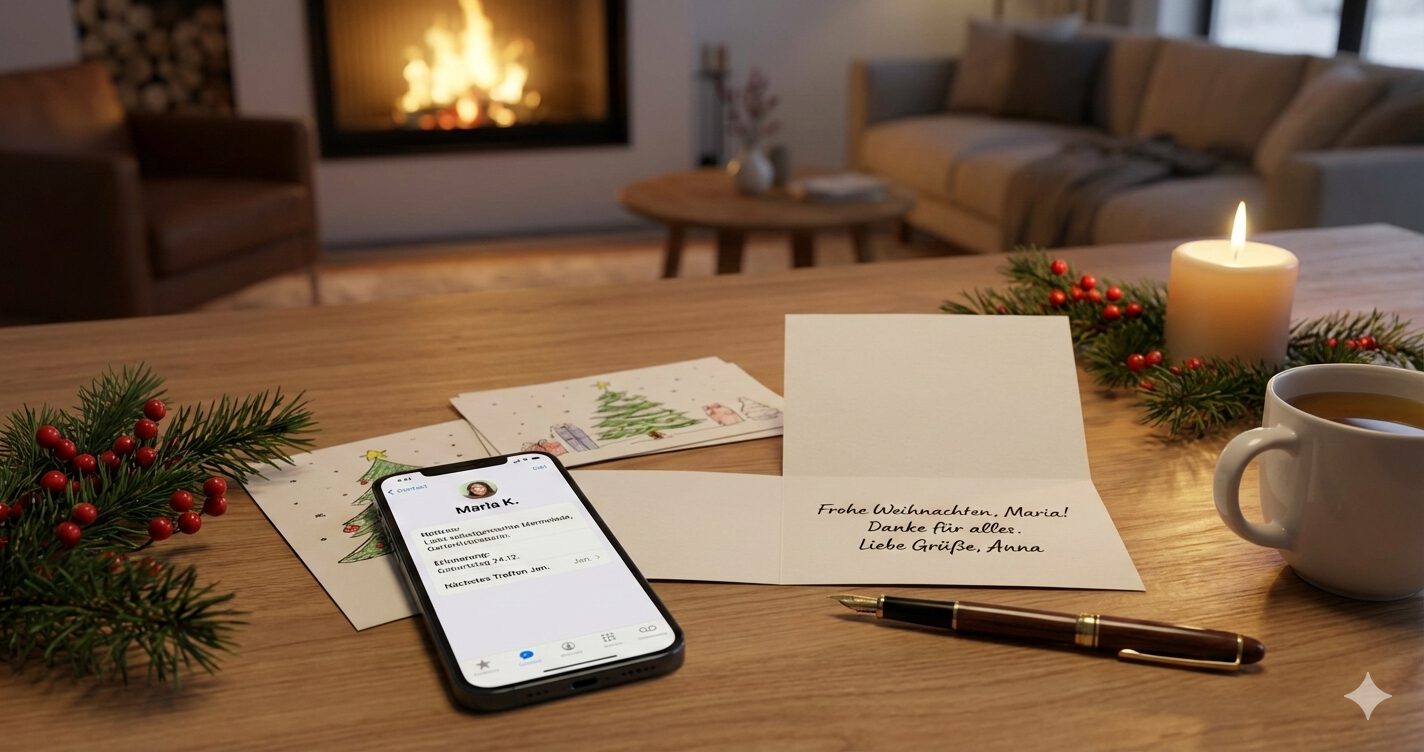
    Be honest: When was the last time you actually bought a stack of Christmas cards, grabbed a pen and wrote more than “Merry Christmas to you all”? Most of us mean well and still end up copy-pasting the same line into WhatsApp or iMessage threads. It feels efficient. It quietly kills emotional impact.

    Here is the twist: Around the holidays, our craving for real connection quietly spikes. At the same time, a US survey found that about 55 % of people feel more lonely or sad during the holidays than during the rest of the year.[1] Many withdraw exactly when a short, personal message could make a massive difference.

    Why the holidays are a relationship checkpoint

    The holidays are like an emotional year-end audit. You scroll through your contacts, stumble upon names and think, “Wow, I really meant to reach out.” Those moments are tiny invitations. Most of them expire unused.

    Anthropologist Robin Dunbar famously showed that our brains can only handle about 150 meaningful relationships at a time, no matter how many contacts sit in our phones.[2] Every December that limit feels very real: We notice who is truly close and who only exists as a name in our address book.

    At the same time, expectations go through the roof: perfect family gatherings, cozy friend nights, deep talks by candlelight. Reality check: In one US survey, three out of five people said their stress levels rise during the holidays, driven by money worries, shopping and family dynamics.[3] No surprise that many people default to generic greetings just to get through the season.

    “Christmas cards are not a mandatory ritual. They are a chance to repair, deepen or quietly revive relationships.”

    What truly personal messages do to the brain

    Now for the science. Researchers at the University of Bath showed in 2024 that personalized gifts and messages significantly boost people’s self-esteem and make them feel more cherished than generic ones.[4] In plain English: If you turn a flat “Merry Christmas” into something like “Hey Sam, I kept thinking about the crazy move you pulled off this year…”, the recipient’s brain reacts differently.

    Across several experiments, personalized gifts changed not only how people rated the gift itself but also how they perceived the relationship. They felt more seen and valued, and they remembered the gesture for longer.[4] Earlier research on greeting cards has shown that cards both reflect and shape social norms and relationship quality over time.[5]

    And it is not just about the recipient. Recent work from Ireland suggests that people who regularly send Christmas cards are also more likely to report better mental health than those who do not.[6] In other words: Expressing care in writing helps both sides.

    “A genuinely personal Christmas message is like a tiny emotional upgrade for the relationship – and for your own mood.”

    Christmas cards 2.0: Digital, personal and still warm

    This does not mean you have to handwrite 50 postcards. Honestly, almost no one will stick with that. Christmas 2.0 can be digital and deeply personal – if you treat people as individuals, not as a mailing list.

    One practical approach: Build a short list of people whose relationship really matters to you. For each person, jot down what happened this year: new job, move, breakup, new baby, big project, a memorable conversation. An app like HighFive can help with that memory work: It lets you store notes, photos and key milestones for your contacts and gives you intelligent reminders for birthdays, anniversaries and other personal dates. All of it stays local on your iPhone, so you get the benefits of a personal CRM without the creepiness of a social network.

    That way, you do not sit there on Christmas Eve frantically scrolling through chats. You already know who you want to reach and why.

    How to write Christmas messages people actually remember

    No need to be a poet. A simple structure goes a long way.

    • 1. Fewer people, more depth: Fifteen truly personal messages beat eighty copy-pasted lines every time.
    • 2. One shared moment: Mention a specific thing from this year (their promotion, your joint project, a funny mishap).
    • 3. One honest feeling: Say what you genuinely appreciate about them – messy, subjective, human.
    • 4. Tiny look ahead: Add one line about how you would like to reconnect in the new year.
    • 5. Your voice: Write the way you talk. A bit of humor, a local reference, an inside joke.

    If you like step-by-step guides, try this mini-routine:

    1. Make your list: Pick 10–20 people you honestly want to stay connected with.
    2. Collect keywords: For each person, write down two or three cues from the past year.
    3. Draft short notes: Turn those cues into four to six sentences tailored to that person.
    4. Spread the timing: Do not send everything on December 24. Use Advent and the days between Christmas and New Year’s.
    5. Follow up: If a real conversation starts, log a short note (for example in HighFive) so you can reconnect more easily in a few months.

    Conclusion: Small messages, big ripple effects

    The holidays are not a contest for who sends the most greetings. They are a chance to invest in the relationships that actually carry you. The research is pretty clear: Personalized messages boost self-esteem, strengthen gratitude and can even support mental health on both sides.[4][6]

    This year, instead of blasting out generic lines, pick your key people, use a few personal details (with the help of tools like HighFive if you like) and send messages that only they could receive. No perfection required. Just specificity and sincerity.

    Take ten minutes today, choose three names and send the first personal Christmas message. The rest tends to unfold from there.

    Sources

    • [1] Public News Service (2023): Loneliness, isolation on the rise around the holidays. Link
    • [2] BBC Future (2022): Dunbar’s number – why we can only maintain 150 relationships. Link
    • [3] Sesame Care (2024): Holiday Stress Survey Results. Link
    • [4] University of Bath (2024): Personalized gifts create lasting emotional connections and enhance self-esteem. Link
    • [5] Weisberg, J. (1976): Greeting Cards as Data on Social Processes. Link
    • [6] RTE (2024): Is sending Christmas cards good for your mental health? Link
  • The Psychology of Relationship Maintenance – Why Small Gestures Matter

    The Psychology of Relationship Maintenance – Why Small Gestures Matter

    Have you ever wondered why a simple “Good morning” kiss or a spontaneous hug often means more than an expensive gift? The answer lies deep within our psychology—and science has fascinating insights on why small gestures make the difference between a superficial acquaintance and a deep, trusting relationship. In this article, we explore the secrets of relationship maintenance and discover how tiny attentions can work big wonders.

    The Impact of Attention and Memory in Social Interaction

    The human brain is a true masterpiece of social perception—and small gestures leave deeper impressions than one might expect. A groundbreaking study on joint attention by researchers at the University of Oxford showed that simply sharing attention on the same object or screen triggers a measurable increase in social bonding. Participants rated their connection with a partner significantly more positively after just a few minutes of shared attention—even without direct communication!

    On a neurobiological level, something fascinating happens: The brain releases a cocktail of “feel-good hormones,” known as DOSE—dopamine, oxytocin, serotonin, and endorphins. Especially oxytocin, the “bonding hormone,” plays a key role: it not only enhances trust and empathy but also activates the brain’s reward system via dopamine release. This explains why small attentions feel so good—they literally trigger a chemical reward.

    Equally impressive is the power of memory: studies show that people in romantic relationships develop heightened attention and better memory for information related to their beloved. That means remembering your partner’s favorite coffee or asking about an important meeting activates positive feelings and neurological reward pathways, strengthening your bond.

    How Small Gestures Build Trust and Connection

    Psychology reveals a fascinating concept called “bids for connection”—tiny attempts to gain the attention and affection of another person. Renowned relationship psychologist John Gottman found that how partners respond to these subtle “bids” determines the success or failure of a relationship. Couples who respond positively to these signals (returning a smile, answering a question, offering a touch) have significantly higher relationship satisfaction, with a breakup rate of just 6% after six years—compared to 83% for couples who ignore these gestures.

    A recent study on relationship satisfaction at the University of Mainz uncovered more details: the ability to perceive and respond to a partner’s needs is the most important factor for stable daily relationship happiness. Couples whose partners regularly showed responsiveness experienced fewer fluctuations in satisfaction and felt overall happier.

    Remarkably, an oxytocin study showed that this “cuddle hormone” enhances positive evaluation of one’s own relationship but not judgments of other couples. This means small loving gestures between partners selectively boost their own bond without distorting general social judgment.

    Tips for Authentic and Sustainable Relationship Maintenance

    Good news: maintaining relationships through small gestures is a skill and doesn’t have to be expensive or time-consuming. Here are science-backed strategies that really work:

    1. The Power of Routine: Consistency beats intensity. Research on autonomy and relatedness in relationships shows that regular small attentions are more effective over time than occasional grand gestures. A daily “How was your day?” or a quick hug before bed continuously activate positive neurochemical processes.

    2. Active Listening as a Superpower: Research confirms that people who feel heard and understood develop significantly more trust. Put away your phone, look your partner in the eyes, and ask follow-up questions. It costs nothing, takes minutes, and leaves deep neurological imprints.

    3. Using Memories Strategically: Tools like HighFive help ensure you don’t forget important dates and personal details. A study on workplace relationships showed that people who remember and acknowledge personal milestones are seen as more trustworthy and competent.

    4. Purposeful Physical Touch: Simple touches—a hand on a shoulder, a brief handshake—release oxytocin and strengthen bonds. During social distancing times, couples with regular physical contact reported more stable relationships.

    5. Authenticity over Perfection: A surprising study found that self-compassion in relationships benefits both the actor and partner. People who are honest about their flaws and forgive themselves create an environment of acceptance and trust that strengthens both partners.

    Conclusion: The Power of Small Things

    Science is clear: small gestures aren’t just nice extras—they are the foundation of stable, happy relationships. They activate our neurochemical reward systems, build trust, and create the emotional security people seek in relationships. The best part? This “superpower” is available to everyone—regardless of budget, schedule, or special talents.

    In a world full of grand gestures and spectacular attentions, paradoxically it is the small, everyday moments of mindfulness that make the real difference. A thoughtful look, a timely reminder, a spontaneous coffee—these mini-investments pay dividends in trust, closeness, and happiness. With tools like HighFive, it gets even easier to never miss these precious opportunities and turn fleeting encounters into lasting bonds.

    Sources:

    • Wahn, B. et al. (2015): Joint attention, shared goals and social bonding. PMC.
    • Corporate Governance Institute (2021): DOSE neurochemicals and employee engagement.
    • Body Chemistry and Leadership Behaviour Study (2024).
    • Therapy Group DC (2025): Bids for Connection in Relationships.
    • University of Mainz (2025): Relationship Satisfaction Fluctuations.
    • Eckstein et al. (2019): Oxytocin and relationship appraisal. PMC.
    • Körner, R. et al. (2024): Self-compassion in romantic relationships.