
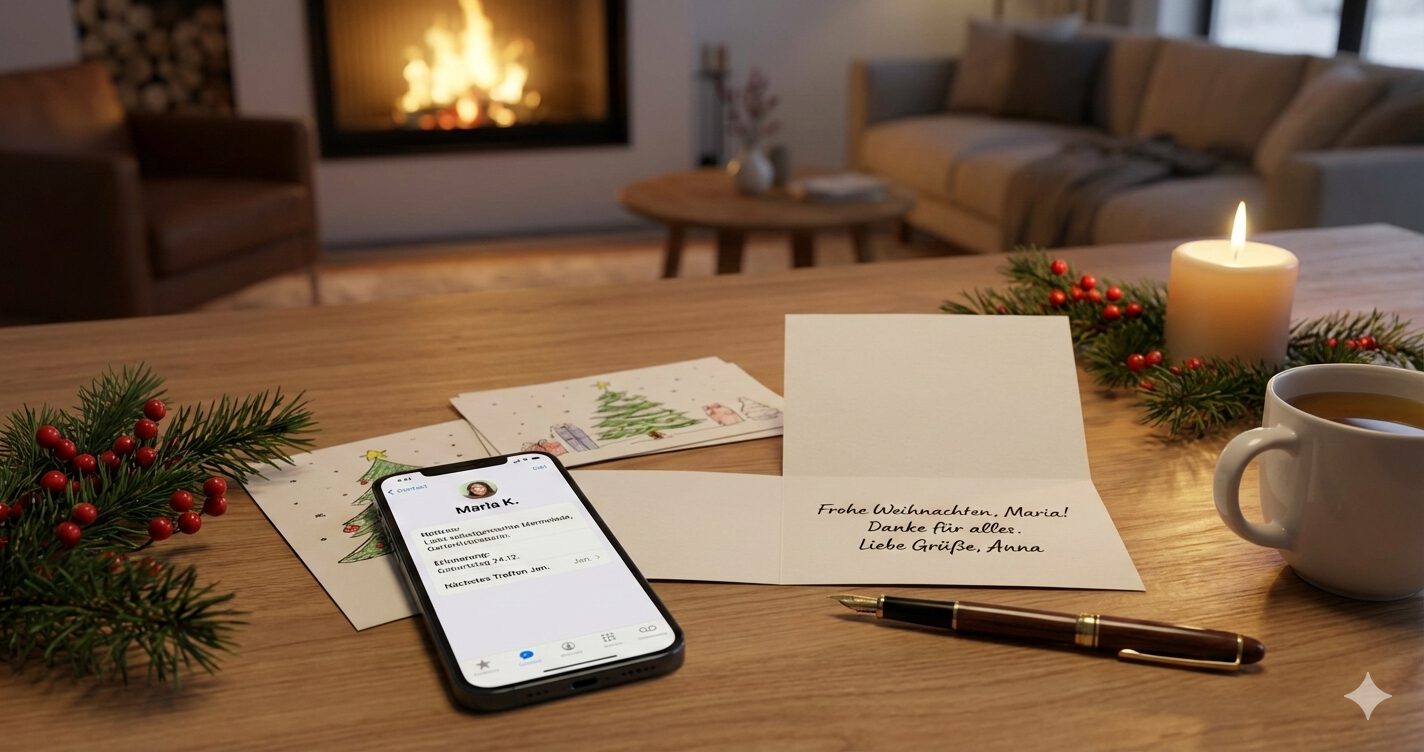
Christmas cards, reloaded: Why your messages matter more than you think
Be honest: When was the last time you actually bought a stack of Christmas cards, grabbed a pen and wrote more than “Merry Christmas to you all”? Most of us mean well and still end up copy-pasting the same line into WhatsApp or iMessage threads. It feels efficient. It quietly kills emotional impact.
Here is the twist: Around the holidays, our craving for real connection quietly spikes. At the same time, a US survey found that about 55 % of people feel more lonely or sad during the holidays than during the rest of the year.[1] Many withdraw exactly when a short, personal message could make a massive difference.
Why the holidays are a relationship checkpoint
The holidays are like an emotional year-end audit. You scroll through your contacts, stumble upon names and think, “Wow, I really meant to reach out.” Those moments are tiny invitations. Most of them expire unused.
Anthropologist Robin Dunbar famously showed that our brains can only handle about 150 meaningful relationships at a time, no matter how many contacts sit in our phones.[2] Every December that limit feels very real: We notice who is truly close and who only exists as a name in our address book.
At the same time, expectations go through the roof: perfect family gatherings, cozy friend nights, deep talks by candlelight. Reality check: In one US survey, three out of five people said their stress levels rise during the holidays, driven by money worries, shopping and family dynamics.[3] No surprise that many people default to generic greetings just to get through the season.
“Christmas cards are not a mandatory ritual. They are a chance to repair, deepen or quietly revive relationships.”
What truly personal messages do to the brain
Now for the science. Researchers at the University of Bath showed in 2024 that personalized gifts and messages significantly boost people’s self-esteem and make them feel more cherished than generic ones.[4] In plain English: If you turn a flat “Merry Christmas” into something like “Hey Sam, I kept thinking about the crazy move you pulled off this year…”, the recipient’s brain reacts differently.
Across several experiments, personalized gifts changed not only how people rated the gift itself but also how they perceived the relationship. They felt more seen and valued, and they remembered the gesture for longer.[4] Earlier research on greeting cards has shown that cards both reflect and shape social norms and relationship quality over time.[5]
And it is not just about the recipient. Recent work from Ireland suggests that people who regularly send Christmas cards are also more likely to report better mental health than those who do not.[6] In other words: Expressing care in writing helps both sides.
“A genuinely personal Christmas message is like a tiny emotional upgrade for the relationship – and for your own mood.”
Christmas cards 2.0: Digital, personal and still warm
This does not mean you have to handwrite 50 postcards. Honestly, almost no one will stick with that. Christmas 2.0 can be digital and deeply personal – if you treat people as individuals, not as a mailing list.
One practical approach: Build a short list of people whose relationship really matters to you. For each person, jot down what happened this year: new job, move, breakup, new baby, big project, a memorable conversation. An app like HighFive can help with that memory work: It lets you store notes, photos and key milestones for your contacts and gives you intelligent reminders for birthdays, anniversaries and other personal dates. All of it stays local on your iPhone, so you get the benefits of a personal CRM without the creepiness of a social network.
That way, you do not sit there on Christmas Eve frantically scrolling through chats. You already know who you want to reach and why.
How to write Christmas messages people actually remember
No need to be a poet. A simple structure goes a long way.
- 1. Fewer people, more depth: Fifteen truly personal messages beat eighty copy-pasted lines every time.
- 2. One shared moment: Mention a specific thing from this year (their promotion, your joint project, a funny mishap).
- 3. One honest feeling: Say what you genuinely appreciate about them – messy, subjective, human.
- 4. Tiny look ahead: Add one line about how you would like to reconnect in the new year.
- 5. Your voice: Write the way you talk. A bit of humor, a local reference, an inside joke.
If you like step-by-step guides, try this mini-routine:
- Make your list: Pick 10–20 people you honestly want to stay connected with.
- Collect keywords: For each person, write down two or three cues from the past year.
- Draft short notes: Turn those cues into four to six sentences tailored to that person.
- Spread the timing: Do not send everything on December 24. Use Advent and the days between Christmas and New Year’s.
- Follow up: If a real conversation starts, log a short note (for example in HighFive) so you can reconnect more easily in a few months.
Conclusion: Small messages, big ripple effects
The holidays are not a contest for who sends the most greetings. They are a chance to invest in the relationships that actually carry you. The research is pretty clear: Personalized messages boost self-esteem, strengthen gratitude and can even support mental health on both sides.[4][6]
This year, instead of blasting out generic lines, pick your key people, use a few personal details (with the help of tools like HighFive if you like) and send messages that only they could receive. No perfection required. Just specificity and sincerity.
Take ten minutes today, choose three names and send the first personal Christmas message. The rest tends to unfold from there.
Sources
- [1] Public News Service (2023): Loneliness, isolation on the rise around the holidays. Link
- [2] BBC Future (2022): Dunbar’s number – why we can only maintain 150 relationships. Link
- [3] Sesame Care (2024): Holiday Stress Survey Results. Link
- [4] University of Bath (2024): Personalized gifts create lasting emotional connections and enhance self-esteem. Link
- [5] Weisberg, J. (1976): Greeting Cards as Data on Social Processes. Link
- [6] RTE (2024): Is sending Christmas cards good for your mental health? Link